
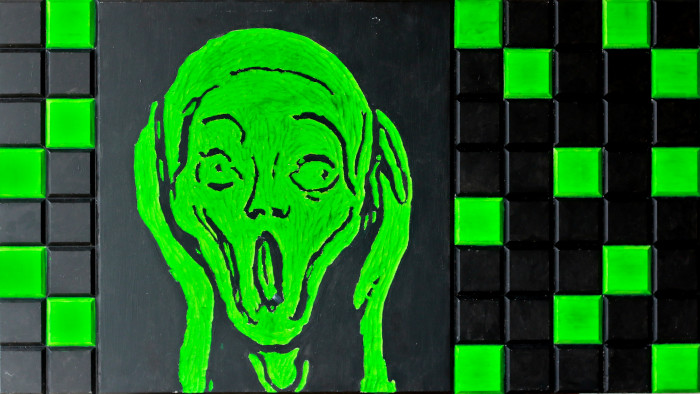
“The social organism is seriously ill, and if we do not heal it, humanity will go under.”
Joseph Beuys
In an era where artificial intelligence generates visually perfect images faster and more precisely than any human painter, the question “Why paint at all?” feels inevitable. Algorithms create technically flawless, inexhaustible imagery. Yet, it is precisely this technological excess that forces us to face an existential question: What does it actually mean to be human?
The answer may lie in returning to our roots. By using materials like wax, honey, and fat, the aesthetics of Joseph Beuys deliberately evoked archaic, tribal environments, and his performances were widely recognized as contemporary shamanic rituals. In the Tungusic language, the word shaman means “the one who knows.” In their book The Shamans of Prehistory, anthropologists Jean Clottes and David Lewis-Williams argue that Paleolithic cave paintings and totems—where all art history begins—served shamanic rituals. The purpose of these practices has always been the same: to appease the spirits and restore harmony within the individual, the community, and the environment. Interestingly, the World Health Organization chooses a similarly holistic definition of health today: as a state of complete physical, mental, and social well-being.
While art in Western capitalist society remains trapped in the gears of the market, we must ask ourselves where we lost this healing component. Beuys viewed Andy Warhol as a “brother from across the ocean.” Since their time, American technological culture has flooded the world—not just with pop culture, but with personal computers, smartphones, and artificial intelligence. As Lev Manovich notes, these are the products of a select few, acting both as meta-tools and the semiotic keys of our time.
I began my artistic journey in the 1990s as part of a small, global community of web artists (net.art). We used the internet as our studio, material, and gallery, questioning how the network would transform the individual and society. Today, artificial intelligence threatens an even more radical rupture. Will our future resemble the dystopia of Mad Max, or will humanity heal its traumas and find a vital harmony with the planet? In both scenarios, we return to shamanism: in the first, as part of post-civilization tribes; in the second, through the activation of intuition and wisdom, both of which are essential to healing our social organism.
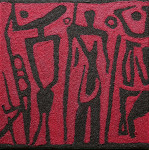
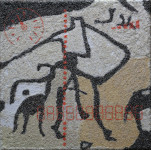
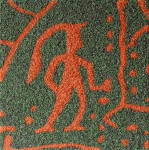
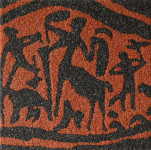
In my own work, I seek a balance between both worlds—between the technology of the present and the wisdom of archaic societies. I combine industrial and digital aesthetics with the visual codes of primal cultures. I deliberately use AI tools to generate graphics in the style of cave paintings. What interests me most are the logical errors—the glitches—that algorithms make when they mimic a form without understanding the underlying logic of what is being depicted. I transfer these technological blind spots onto the painted surface, breathing myths into them and connecting them with archetypes. In this way, the objects on which they appear become contemporary totems.
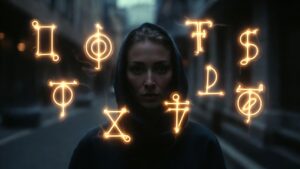
Alongside these visual icons, I create new signs, symbols, and scripts. Various ancient writing systems attributed archetypal meanings to symbols beyond their mere sound; my proprietary software system, Sigilon, follows this tradition, allowing users to create their own symbols (seals or sigils) with personal meaning.
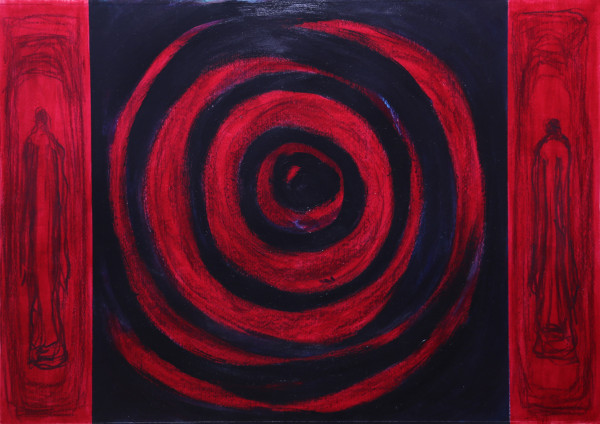
Industrial laminated wooden panels often serve as the surface for my paintings. Wood is an organic medium that carries a record of Earth’s past climate within its rings. The contrast between the raw wood, finished with a clear varnish, and the matte surface of the acrylic paint creates a tension between the natural and the artificial. I complement this with other tactile materials such as sand, rope, and canvas.
We constantly interpret the world around us through language, but the language of neoliberal society and organized religions can only express what is already familiar and secular. In my work, I try to cross these boundaries and express what lies beyond words: the feeling that everything in the universe is sacred, alive, and inextricably intertwined.
Despite the gravity of these themes, a certain element of humor is usually present in my work. In spiritual practices, from shamanism to Zen, laughter is not a sign of superficiality, but the highest form of wisdom. Shamans often acted as sacred tricksters, using humor to shatter rigid social taboos and the ego. When I play with the absurd glitches that algorithms produce while mimicking human tradition, I use humor to remind us that our “truth” is just a fluid concept. Laughter instantly liberates us from the seriousness of the rational mind, releases our tension, and opens us up to a truly wordless experience of freedom.
In such a world, big words are unnecessary. It is enough for forces and energies to enter into the right relationships. This is the very essence of my work: to bring visual elements and entities into such harmony that their mere presence helps create peace within the individual, society, and the planet.
I invite you to pause your inner dialogue for a moment, and try to feel this hidden energy with your entire body, mind, and soul.
