
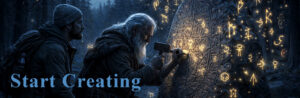
Start Creating Magic Symbols
The Re-Enchantment of the Membrane
Why the symbol works, regardless of your skepticism?
The Great Interruption: From Shamanism to Commodity
Art history does not begin in the salon; it begins in the dark. As anthropologists Jean Clottes and David Lewis-Williams famously argued in The Shamans of Prehistory, the cave paintings of the Upper Paleolithic were not merely aesthetic exercises. The cave wall was a “membrane” between worlds, and the painted image was a ritualistic technology for navigation.
However, the last few centuries have seen a “Great Interruption.” The rise of the private gallery and the art-as-commodity system has redefined art as a financial asset—a product for sale—rather than a psychic necessity. Sigilon is a move to reconnect with the membrane. It is a return to a time when the image was an operational force, not just a luxury object.
The Newtonian Cage: The Illusion of the Calculated World
Our contemporary Western mindset remains largely trapped in a 17th-century Newtonian cage—a worldview that treats the universe as a predictable, clockwork machine. This perspective has been further flattened by a “Financial Mindset,” where every human experience is expected to balance to the last cent. This obsession with a calculated, linear reality ignores the fact that actual reality is a complex, non-linear, and inherently unpredictable field. When we treat the soul as an accounting problem, we lose the ability to navigate the deeper mysteries of existence. Sigilon serves as a deliberate departure from this rigid arithmetic, inviting the user to step out of the spreadsheet and into a symbolic space where meaning is found in complexity.
The Non-Local Canvas: Quantum Paradigms and the Observer
For over a century, the rigid materialism of the Enlightenment has been dismantled by the discoveries of quantum theory. Concepts such as non-locality, entanglement, and the “observer effect”—pioneered by thinkers like Niels Bohr and Werner Heisenberg—suggest that the universe is not a collection of isolated objects, but a participatory web of events where mind and matter are linked.
When we engage with symbols, we operate in the “quantum gap”—the space where intent influences outcome. Sigilon provides a modern framework for a “spiritual” world grounded in the scientific reality that the universe is more “thought-like” than “thing-like.”
The Biological Altar: The Efficacy of the Open-Label Placebo
In the contemporary clinical view, the “placebo effect” is often misunderstood as a trick. However, researchers like Ted Kaptchuk at Harvard have proven the efficacy of the “Open-Label Placebo”: even when patients know they are receiving an inert substance, the ritual of treatment triggers a real physiological healing response.
The sigil acts as a “biological altar.” The human nervous system is programmed to respond to symbolic ritual regardless of intellectual skepticism. We do not need to “believe” in the power of the sign for the sign to exert its influence on our biology; the brain’s internal pharmacy responds to the ritual of the Sigil itself.
The Archetypal Interface: The Collective Operating System
Carl Jung suggested that the human psyche is pre-loaded with “Archetypes”—universal, inherited patterns residing in the Collective Unconscious. Jung viewed the creation of symbols as an act of Active Imagination, a necessary bridge between the conscious self and these deep, pre-linguistic structures.
Within the Sigilon laboratory, we treat the screen as a psychological mirror. When a user generates a sigil, they facilitate a dialogue with the “software” of the soul, using the archetypal language of the image to order the chaos of the internal world.
The Ontological Pivot: Meaning-Making in the Age of AI
As Artificial Intelligence masters the art of production—generating images, text, and code with superhuman efficiency—it forces an existential question: What remains of the human? When the machine can “produce” anything better than we can, our value shifts from the process of making to the sovereignty of meaning.
AI can generate the form, but it cannot possess the intent. In this new era, being human means being the “Intender.” By reclaiming the creation of personal symbols, we move from being “producers” of content to “meaning-makers” of spirit.
Social Sculpture: Healing the Social Organism
Joseph Beuys famously diagnosed the “social organism” as being in a state of terminal illness, warning that without a return to aesthetic and spiritual “wisdom,” humanity would succumb to its own hyper-rationality. Words like “wisdom” have been deleted from our vocabulary because they cannot be measured by a spreadsheet.
Sigilon is a project of Social Sculpture. Following in the lineage of Hilma af Klint and Austin Osman Spare, it is a radical refusal to let the sacred be erased by the mundane. By reclaiming our right to create our own ciphers and talismans, we engage in a necessary re-enchantment of a world that has been stripped of its meaning.
A Lineage of Thought & Practice
- Art: Hilma af Klint, Austin Osman Spare, Joseph Beuys.
- Science: Wolfgang Pauli, Niels Bohr, Werner Heisenberg, Ted Kaptchuk.
- Psychology & Myth: Carl Jung, Joseph Campbell, Jean Clottes.