
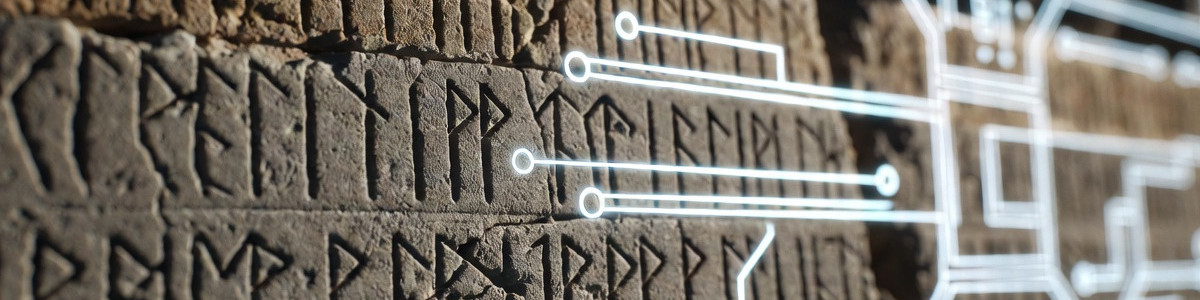
As we enter the era of high-level Artificial Intelligence, the question of “magic” is no longer a relic of the past—it is becoming an essential tool for the future.
“The most significant thing that AI will trigger is a reckoning of who and what we are. For centuries, we identified ourselves with the products of our labor. Now, AI can do almost everything better than we can. So, what remains for us?”
If machines have stripped away our productivity, all that remains is our intent. Sigilon is an interface for directing that intent. Here is how “magic” actually functions through the lens of science, psychology, and speculative physics.
1. Neurobiological Anchoring (NLP)
In Neuro-Linguistic Programming (NLP), we use a concept called anchoring. When you create a Sigil—a unique geometric form that carries your specific affirmation at its core—you are creating a visual anchor.
Every time your eye grazes this symbol, it triggers a specific neural pathway associated with your goal (e.g., health, clarity, or success). This isn’t mysticism; it is attentional optimization. Your Reticular Activating System (RAS) begins to prioritize information in your environment that aligns with that goal, filtering out the noise and highlighting opportunities you previously missed.
2. The Placebo Effect: A Digital “Pill” Without the Chemistry
Scientific studies on “Open-label Placebos” prove that the placebo effect works even when patients know they are taking a sugar pill. The body responds to the ritual and the intent, not the chemical compound.
Sigilon acts as a visual placebo. By imbuing a symbol with meaning, you bypass the analytical mind and trigger biological responses within your own system. The symbol becomes the UI (User Interface) through which your mind communicates with your biology.
3. Quantum Reality and the Observer Effect
In quantum mechanics, the “Double-Slit Experiment” famously demonstrated that the act of observation influences the behavior of particles. If consciousness has an impact at the quantum level, then intent is a fundamental component of reality.
-
The Multiverse: Modern String Theory and the Many-Worlds Interpretation suggest that we may be navigating different probability lines through the strength of our focus.
-
Energy-Based Intelligence: Could parallel realities house intelligences or energetic organisms that current science lacks the instruments to measure? While science cannot prove their existence, it cannot disprove them either. Throughout history, sigils have functioned as “antennas” designed to bridge the gap between these dimensions.
4. The Institutional Interest in “The Unseen”
If magic were merely superstition, intelligence agencies and military industrial complexes would not have spent decades investigating it. Documents released by the CIA regarding Project Stargate reveal that millions were spent researching “Remote Viewing” and the influence of consciousness over matter. The institutional interest in psychotronics suggests that the informational influence of the mind is a tangible domain of power—one that mainstream science often leaves at the door.
5. Myth as Map, Not Dogma
Myths are not failed history; they are maps of the psyche. Runic signs and sigils are languages refined over millennia by our ancestors to encode complex psychological processes into simple, potent forms.
Sigilon translates these ancient archetypes—such as the Norse Runes—into digital code. It does not demand faith in ancient gods; rather, it empowers you to create your own personal myth. In a world where AI generates our art and writes our poetry, the act of creating your own symbol is an act of rebellion—a reclamation of individual identity.
The Verdict
In the Sigilon system, magic is not an escape from reality; it is a technology of consciousness. It is the use of an algorithm to find a focal point for your will within the digital chaos.
It works even if you don’t believe in it.
%20-%20https://spiller.si/does-magic-actually-work/)